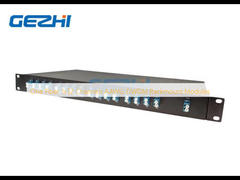
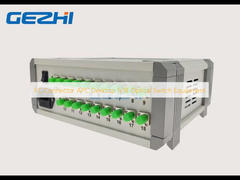
Brief: Let’s dive in — see this solution in action and notice the key moments. In this video, we showcase the Gezhi Dual Fiber 40CH AAWG Athermal Arrayed Waveguide Grating in operation. You'll see a detailed walkthrough of its high-density, low-loss passive optical module design, demonstrating how it provides reliable WDM multiplexing and demultiplexing for data center and metro network applications without requiring power or cooling.
Related Product Features:
Completely passive operation requiring no power or cooling for enhanced reliability.
High channel isolation exceeding 30 dB for adjacent channels ensures signal integrity.
Built-in multiplexer and demultiplexer functionality operates on two network fibers.
Ultra-low insertion loss below 4.5 dB maximizes transmission distance and performance.
Athermal AWG technology with Gaussian design provides excellent wavelength stability.
Designed for high-density applications in a standard 19-inch 1U rack mount frame.
Supports 40 channels with 100 GHz spacing across the C-band wavelength range.
Ideal for WDM transmission, optical signal processing, and metro network architectures.
Ч.З.В.:
What are the key advantages of the athermal AWG technology used in this module?
The athermal AWG technology eliminates the need for active temperature control, providing excellent wavelength stability within ±0.05 nm across operating temperatures from -5°C to 65°C, ensuring reliable performance without power consumption.
How does this 40-channel AAWG module handle multiplexing and demultiplexing?
This dual fiber module features built-in multiplexer and demultiplexer functionality in a single unit, working on two network fibers to combine and separate 40 optical channels with high isolation and low insertion loss.
What types of network applications is this AAWG module suitable for?
It's ideal for WDM-based add-drop multiplexing, optical signal processing, wavelength selective routing, and both metro and long-haul network applications, particularly in data centers requiring high channel counts.
What are the optical performance specifications for insertion loss and channel isolation?
The module offers ultra-low insertion loss between 3.5-4.5 dB, adjacent channel isolation of 30 dB minimum, non-adjacent isolation of 40 dB minimum, and total channel isolation of 33 dB minimum for superior signal quality.